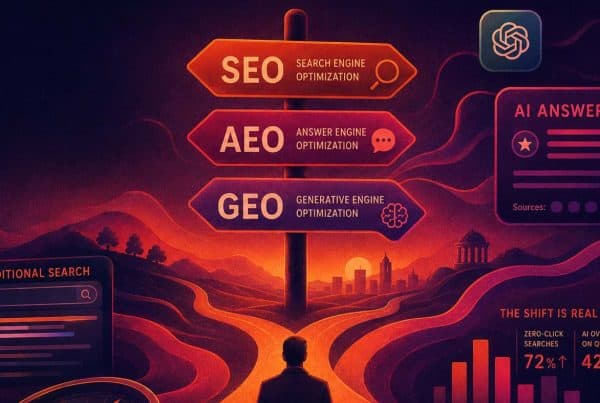
SEO has evolved significantly with the rise of AI, transforming how search engines rank content and how users find information. Here’s what you need to know:
- Old tactics are outdated: Keyword stuffing and backlink volume no longer work. AI prioritizes context, user intent, and quality content.
- Zero-click searches dominate: AI-generated answers often provide information directly in search results, reducing website traffic but boosting brand visibility.
- Content quality matters: AI evaluates depth, expertise, and user engagement, making Google’s E-E-A-T framework (Experience, Expertise, Authoritativeness, Trustworthiness) more important than ever.
- Local SEO is more sophisticated: AI considers factors like proximity, review sentiment, and data accuracy for local rankings.
To stay competitive, focus on creating well-structured, detailed content that directly answers user questions. Use schema markup for better AI understanding, maintain consistent business details, and encourage authentic reviews. Businesses that adapt now will stand out in this AI-driven landscape.
In this article...
How AI Affects Modern SEO
AI is transforming how search engines work, focusing on understanding user intent and delivering results that align with what users are truly looking for. This shift is redefining rankings, engagement, and how businesses approach SEO.
AI-Powered Search Engines and Their Impact
Search engines have evolved to do more than just match keywords – they now aim to grasp the meaning behind search queries. For instance, Google’s advanced AI systems analyze user intent, language nuances, and context to provide more precise results. This shift underscores the need for SEO strategies that go beyond traditional keyword tactics.
Keyword stuffing is no longer effective – it can even hurt your rankings. AI-driven algorithms prioritize content that answers user questions meaningfully. Instead of focusing on repeating keywords, content must be relevant, complete, and contextually rich [1].
The rise of semantic search has further refined how engines process queries. Using natural language processing (NLP), search engines now understand synonyms, related ideas, and broader meanings. This allows well-structured content to rank for various related terms, even if those terms aren’t explicitly targeted [1]. Additionally, the growth of voice search and AI assistants has accelerated this trend, emphasizing conversational and comprehensive content [1][2].
The Rise of Zero-Click Searches
Zero-click searches are one of the biggest challenges in modern SEO. These happen when users find their answers directly in search results, thanks to AI-generated summaries, featured snippets, or knowledge panels, without needing to click through to a website.
This shift means that businesses need to rethink their metrics. Instead of focusing solely on clicks, the emphasis is now on establishing authority and creating content that AI systems trust enough to feature in their responses [2]. While fewer clicks might occur, being highlighted in AI-generated answers can boost brand awareness and authority.
To adapt, businesses must create content that is not only helpful but also recognized as the most reliable and comprehensive source on a topic. As zero-click searches become more common, prioritizing content authority and context has become a critical part of SEO success.
The Role of Context and Authority in AI-Driven SEO
AI systems heavily focus on content quality and its ability to answer user questions, making Google’s E-E-A-T framework – Experience, Expertise, Authoritativeness, and Trustworthiness – more crucial than ever. Content must also provide comprehensive coverage, addressing topics from multiple angles to be considered complete [2].
For example, Ralf van Veen, a Senior SEO specialist, helped a financial services client by shifting their content strategy to emphasize completeness rather than keyword repetition. Within three months, the client saw a 20% increase in impressions and a 15% boost in organic traffic [3]. This highlights the importance of topical authority – demonstrating deep knowledge on a subject increases the chances of being featured in AI-generated answers [3].
Content that is thorough and well-connected consistently outperforms text that relies on outdated keyword strategies [3]. AI systems can easily identify when content is genuinely helpful versus when it’s designed to manipulate rankings. As a result, authentic expertise and a focus on user needs are more critical than ever in the AI-driven SEO landscape.
How to Optimize Content for AI Overviews and LLMs
Crafting content that AI systems can easily process and highlight requires a thoughtful approach that extends beyond conventional SEO methods. The aim is to make your content so clear and detailed that AI algorithms select it as the go-to resource for user queries.
How to Structure Content for AI Systems
Start by providing a direct, concise answer to the primary question your audience is asking. Use hierarchical headings like H1, H2, and H3 to organize your content logically. These headings should clearly outline what each section covers, making it easier for AI systems to understand and navigate.
Keep your paragraphs short – two to three sentences max. Breaking down information into smaller, digestible sections not only helps AI systems process your content but also makes it more user-friendly for readers who prefer to skim.
Incorporate specific data and real-world examples whenever possible. This level of detail adds credibility and signals to AI that your content is a reliable and comprehensive resource.
To take it a step further, structured data can enhance how AI interprets and categorizes your content.
Using Structured Data and Schema Markup
Clear organization is just the first step. Structured data, like schema markup, plays a crucial role in helping AI systems accurately understand and classify your content.
Schema markup acts as a bridge between your content and AI, clarifying what your content is about and where it fits. For example:
- FAQ schema is ideal for question-and-answer sections, signaling to AI which parts of your content address common queries.
- Article schema provides details like your content’s topic, publication date, author, and key takeaways.
- Local Business schema communicates essential business details such as hours, location, contact information, and services.
- Product and Service schema highlights what you offer, including pricing, availability, ratings, and descriptions.
To ensure your schema markup is implemented correctly, use tools like Google’s Rich Results Test. Properly applied schema markup can significantly boost your chances of appearing in AI-generated summaries and overviews, increasing your visibility and reach.
Local SEO Methods for AI-Driven Search
Local businesses are navigating a new landscape shaped by AI-driven search. Search engines now lean heavily on machine learning to grasp user intent and deliver results tailored to location, context, and user behavior. This shift has made traditional local SEO tactics less effective, pushing businesses to rethink strategies for keywords, reviews, and data consistency.
AI systems now consider far more than just keywords when processing local searches like “best pizza near me” or “dentist open Sunday.” Factors such as proximity, business hours, review sentiment, and even seasonal trends all play a role in determining which results appear at the top.
Location-Based Keywords and Relevance
Gone are the days when stuffing “City Name + Service” into every piece of content could boost rankings. AI algorithms now focus on contextual relevance rather than keyword density. To keep up, businesses need to create content that naturally weaves in local context. For instance, instead of generic phrases, write about issues specific to your area – like neighborhood challenges, local regulations, or seasonal concerns that affect your customers. Proximity is also a key ranking factor, so addressing local needs effectively in your content is vital. A restaurant that highlights nearby landmarks, local suppliers, or community events is more likely to rank higher than one that simply repeats its address.
When using geographic terms, aim for natural integration. Phrases like “serving families in the Riverside District” or “helping homeowners throughout the Greater Phoenix area” make your service areas clear without sounding forced. This approach not only improves readability but also helps AI systems better understand your target audience.
But keywords are just one piece of the puzzle. Your online reputation, especially through reviews, plays a major role in local rankings.
How Online Reviews and Reputation Affect Rankings
AI systems have become adept at analyzing reviews, diving deeper than just counting five-star ratings. They evaluate the quality and relevance of reviews to assess how well a business meets local needs.
Consistency is key. While recent reviews hold more weight, businesses with steady, genuine feedback over time tend to perform better than those with sudden spikes in ratings. AI can spot patterns that suggest fake reviews, so focus on encouraging honest feedback from satisfied customers.
How you respond to reviews also matters. AI algorithms now factor in the quality of your replies to both positive and negative feedback. Personalized, thoughtful responses that address specific concerns show strong customer service and engagement with the local community.
The language in reviews can also impact rankings. Reviews that mention specific locations, landmarks, or neighborhood details send stronger local signals than vague comments. Encourage customers to share detailed accounts of their experience, including how your business addressed their local needs.
Managing Local Business Data and Directory Listings
AI-driven search has raised the bar for data accuracy and consistency. Search engines cross-check your business information across multiple sources to verify its reliability, so keeping your details consistent everywhere is critical.
Your Name, Address, and Phone number (NAP) must match exactly across all platforms. Even minor discrepancies can confuse AI systems and hurt your rankings. To avoid this, create a master document with your exact business details and ensure it’s used consistently.
Business hours are another crucial factor. AI prioritizes businesses with accurate, detailed hours, including updates for holidays or temporary changes. Ensure your website, Google Business Profile, and other listings all reflect the same information.
When choosing categories for your business, specificity is key. Opt for precise categories that align closely with your services. For example, a “family law attorney” is more likely to rank well for relevant searches than a general “lawyer”, as AI systems can better match specific user intent.
Finally, while consistency is important, avoid duplicating your business descriptions word-for-word across platforms. AI may flag identical content as spam. Instead, create variations that convey the same key details using different phrasing. Focus on highlighting your local expertise and specific services to stand out in AI-driven search results.
Mazzi Studios has crafted solutions to help businesses thrive in the rapidly changing landscape of AI-driven SEO. Their approach is especially impactful in sectors like healthcare and B2B, where precision and clarity are critical for success. By combining traditional marketing expertise with cutting-edge AI tools, the agency addresses both the technical demands of modern search engines and the strategic goals of businesses aiming to maintain their digital visibility.
AI-Powered Keyword Research and Content Optimization
Gone are the days when keyword research was all about search volume and competition. Mazzi Studios takes it a step further by using AI-powered tools and advanced analytics to dig into user intent and the context behind search queries. They focus on how AI systems interpret content, moving beyond simple keyword density to explore semantic relationships and establish topical authority.
Their proprietary process ensures that content aligns with the tone and expectations of specific industries. For healthcare, this means creating content that balances medical expertise with accessibility. For B2B clients, the focus shifts to producing thought leadership pieces that showcase authority in technical or niche subjects.
Mazzi Studios also optimizes content for seamless AI parsing. This includes creating clear topic clusters, maintaining consistent terminology across a website, and logically linking related content. These practices ensure that content not only resonates with users but also performs well in AI-driven search results.
Local SEO Expertise and Compliance
Local SEO requires precision, and Mazzi Studios excels in managing the complexities of this space, particularly for healthcare providers and local B2B markets. They go beyond the basics by verifying and optimizing local business data to ensure accuracy and consistency across platforms.
For healthcare providers, the agency uses advanced structured data markup to help AI systems better understand services, specialties, and qualifications. They also focus on reputation management, leveraging authentic reviews to build trust. In the B2B space, the emphasis shifts to optimizing for location-specific searches, such as “IT consultants in Chicago” or “medical equipment suppliers in Houston”, helping businesses establish authority in their geographic markets.
Service Plans for Small to Mid-Sized Businesses
To meet the diverse needs of businesses adapting to AI-driven SEO, Mazzi Studios offers three service tiers designed to cater to different stages of digital growth:
| Plan Level | Key AI-SEO Features | Best For |
|---|---|---|
| Basic | Marketing strategy, SEO optimization, AI-friendly website structure | Small businesses starting their digital journey |
| Standard | Advanced AI optimization, PPC campaigns, brand strategy, comprehensive website development | Growing businesses aiming for competitive visibility |
| Premium | Full AI-powered marketing suite, custom development, in-depth SEO analysis, advanced PPC management | Established businesses seeking a robust digital presence |
The Basic plan is ideal for small businesses, such as local healthcare practices or B2B service providers, just beginning to adapt to AI-driven SEO. It focuses on building a strong foundation with consistent business information, structured data, and AI-friendly content.
The Standard plan is tailored for growing businesses looking to enhance their digital visibility. It includes advanced AI tools for keyword research, competitor analysis, and content strategies designed to optimize for AI-generated summaries and featured snippets. This plan is especially popular among mid-sized medical practices and B2B companies in competitive markets.
The Premium plan offers a comprehensive suite of AI-driven marketing tools. It includes custom AI agent development, advanced automation for content creation and distribution, and detailed performance analytics across multiple platforms. Larger healthcare organizations and well-established B2B companies often choose this plan for its ability to deliver a fully integrated digital marketing strategy.
All plans include continuous monitoring and updates, allowing Mazzi Studios to refine strategies as AI-driven search algorithms evolve. This adaptability ensures that clients stay ahead of the curve in an ever-changing digital landscape.
Staying Competitive in AI-Driven SEO
The digital marketing world has undergone a seismic shift. As zero-click searches and AI-generated summaries deliver instant answers without the need for website visits, businesses that don’t adjust to AI-driven SEO risk fading into obscurity. To stay visible, it’s time to rethink how content is created, structured, and optimized.
Success in this evolving landscape boils down to one key principle: context and authority are more critical than ever. Modern search engines powered by advanced language models now assess content based on its semantic depth, expertise on a topic, and ability to provide precise, user-focused answers. Outdated tricks won’t cut it anymore – businesses need to embrace structured data and craft content that aligns with user intent.
For local businesses, the challenge is even more specific. As AI becomes better at interpreting geographic relevance and user proximity, maintaining accurate business details, encouraging genuine reviews, and prioritizing location-based optimization are essential for staying competitive in local markets.
Industries like healthcare and B2B face their own hurdles. They must strike the perfect balance between technical accuracy and user-friendly content to meet the expectations of both human readers and AI systems.
Time is of the essence. Businesses that start adapting to AI-driven search now will gain a significant edge over those that delay. Focusing on structured data, refining content strategies, and improving local SEO will lay the groundwork for long-term success as AI continues to dominate search results. This rapid evolution highlights the importance of seeking expert guidance to navigate the complexities of modern SEO.
The future of SEO isn’t just about climbing the rankings – it’s about becoming the trusted authority that AI systems rely on for accurate, useful information. Companies that embrace this shift today will position themselves to thrive in an increasingly competitive digital landscape.
FAQs
How can businesses update their SEO strategies to thrive in an AI-powered world?
To keep up in an ever-evolving AI-powered SEO world, businesses need to focus on making their content AI-friendly. This includes tailoring it for tools like large language models (LLMs) and AI-driven search results. The key? Craft clear, well-structured content that directly addresses user questions. This approach helps your content shine in AI-generated summaries, boosting your visibility.
It’s also smart to pay attention to voice search optimization and conversational keywords. With more people relying on smart assistants and mobile devices, content that mirrors natural speech patterns has a better chance of being discovered. Additionally, incorporating structured data and using AI-optimized alt text for images can make your content easier for search engines to understand and rank.
By staying ahead of these changes and fine-tuning your strategies, you can ensure your business remains visible and relevant in the ever-changing digital world.
How do zero-click searches affect website traffic, and how can businesses use them to boost brand visibility?
Zero-click searches have become a game-changer in how people interact with search engines. These are instances where users get their answers directly on the search results page without clicking through to a website. Studies suggest that more than 60% of searches now fall into this category, which has significantly impacted website traffic. While this trend presents challenges for organic traffic, it also opens up new avenues for businesses to boost brand visibility.
The key to staying relevant lies in optimizing your content for SERP features like featured snippets, knowledge panels, and FAQs. These tools allow your brand to stand out prominently in search results, even if users don’t click through to your site. By showcasing your business as a reliable source of information, you can maintain your influence and keep your brand top-of-mind in today’s fast-evolving, AI-driven search environment.
Why is the E-E-A-T framework important for AI-focused SEO, and how can content creators adapt to meet these standards?
The E-E-A-T framework – Experience, Expertise, Authoritativeness, and Trustworthiness – plays a crucial role in AI-driven SEO. It guides search engines in assessing the quality and reliability of content. Since AI algorithms favor content that is accurate, relevant, and dependable, E-E-A-T becomes a cornerstone for achieving better rankings and visibility.
To align with E-E-A-T, content creators should focus on these key areas:
- Highlight real-world experience by sharing practical insights or firsthand knowledge that adds value.
- Show expertise through well-researched, accurate, and in-depth information.
- Build authority by referencing reliable sources and maintaining a strong, credible reputation.
- Foster trust with transparent, honest, and user-centered content.
By following these principles, creators can produce content that appeals to both AI systems and human readers, boosting engagement and search performance.
Last Updated on December 17, 2025.

Marketing leader, drummer, husband and father of two amazing teenage athletes. Ricardo has been involved in digital marketing for over decades holding leadership positions for various healthcare tech companies. He founded Mazzi Studios during the pandemic to help businesses of all industries plan and execute marketing strategies.