Last week, I watched an AI agent complete in 10 minutes what used to take my team three hours: researching competitors, analyzing their content gaps, and drafting a strategic report. It wasn’t perfect, but it was 80% there – and that’s exactly the point.
In this article...
The AI Agent Quiet Revolution Happening Right Now
If you’re like most marketers and business leaders, you’ve probably experimented with ChatGPT or similar tools. Maybe you’ve used them to polish an email or brainstorm campaign ideas. But what’s happening behind the scenes is far more profound than these casual interactions suggest.
We’re witnessing the emergence of AI agents – sophisticated digital assistants that don’t just respond to prompts but actively pursue goals, make decisions, and execute multi-step tasks with minimal human oversight. Unlike the chatbots of old that could barely handle “What are your hours?”, today’s AI agents can research your competitors, write personalized outreach emails, optimize your content for search engines, and even manage customer conversations end-to-end.
The numbers tell the story: 99% of developers are exploring or building AI agents for enterprise use, and we’re rapidly approaching what industry leaders call “the year of the AI agent.”
But here’s what the statistics don’t capture – the human experience of working alongside these digital teammates and how they’re fundamentally changing what it means to be productive in 2025 (and beyond).
From “Hello, I’m a Bot” to “Consider It Done”
Remember those frustrating website chatbots that would trap you in endless loops?
“I didn’t understand that. Please try again.”
We’ve come a long way.
The evolution happened faster than most of us realized. Let’s recap:
The Early Days (1990s-2000s): Those first “AI” helpers were essentially fancy flowcharts. ELIZA, one of the earliest chatbots from the 1960s, could mimic a therapist by reflecting your statements back as questions. Impressive for its time, but try asking it to help with your quarterly marketing strategy and you’d get gibberish.

Joseph Weizenbaum from MIT invented ELIZA, what today might be called the first chatbot. Released in 1966, that ran a script meant to mimic a first visit to the therapist. (MIT) Image source: CBC.ca
The Smartphone Era (2010s): Siri changed everything when she arrived in 2011. Suddenly, you could talk to your phone and it would usually understand. Google Assistant and Alexa followed, bringing AI into our homes and daily routines. Yet these assistants were still limited to single commands – great for setting timers, not so great for complex problem-solving.
The Learning Phase (Early 2020s): Behind the scenes, AI systems became exceptionally proficient at specific tasks. Netflix’s recommendation engine learned your taste in shows. Banking AI started catching fraud in real-time. These specialized agents could analyze massive datasets and make decisions, but each was a specialist in its narrow domain.
The ChatGPT Moment (Late 2022): When OpenAI released ChatGPT to the public, everything shifted. Suddenly, AI could hold coherent conversations, write code, create content, and reason through problems. The technology had crossed a threshold – it wasn’t just processing information, it was thinking (or at least appearing to think) through problems step by step.
The Agent Era (Now): Today’s AI agents take that reasoning ability and combine it with the power to take action. Give an agent a goal like “research our top 5 competitors and create a content gap analysis,” and it will autonomously break that down into sub-tasks: identify competitors, crawl their websites, analyze their content themes, compare against your content, and compile findings into a report.
As IBM researchers explain, modern AI agents use large language models’ reasoning capabilities combined with tool integrations to plan and execute tasks end-to-end. It’s like having a digital employee who never sleeps, never gets bored, and can process information at superhuman speed.
The transformation is so rapid that Microsoft’s Satya Nadella recently described his vision of an “AI agent tier“ in software – a layer where AI agents work across all your applications to automate entire workflows. We’re not completely there yet, but the foundation is solid.
How AI Agents Are Rewriting the SEO Playbook
As someone who’s been in digital marketing for over two decades, I can tell you that SEO has never changed this quickly. The rise of AI agents is disrupting both how we create optimized content and how search engines deliver results to users.
Content Creation Gets Superpowers
Here’s what used to happen: You’d spend hours researching keywords, analyzing competitor content, writing a draft, then going back to optimize for SEO. Now? AI agents are collapsing that entire workflow into a single, streamlined process.
Modern SEO AI agents don’t just write content – they optimize as they go. Tell an AI agent to create an article about “sustainable packaging solutions for e-commerce,” and it will automatically research relevant keywords, structure the content with proper headings, weave in semantic keyword variations, and even suggest internal linking opportunities. What once took a team of specialists (researcher, writer, SEO analyst) can now be handled by one person working with an AI agent.
The scale advantage is staggering. 85% of marketers believe generative AI will transform content creation, and it’s easy to see why. A single content manager with the right AI tools can now produce the output that previously required a small army.
But here’s the crucial part – it’s not about replacing human creativity.
It’s about amplifying it. As cliche as it sounds, its true.
The most successful content teams I’ve observed use a hybrid approach: AI handles the heavy lifting of research, keyword analysis, and first drafts, while humans add the strategic thinking, brand voice, and unique insights that only come from real experience. Humans are the “editors in chief”.
As one SEO expert recently put it: “AI won’t replace SEO professionals, but those who use AI will likely outperform those who don’t.” More cliche, but it applied to all verticals.
The Death of Keyword Stuffing (For Real This Time)
If you’ve been in SEO long enough, you remember the keyword stuffing era. Those days are definitively over, thanks to AI’s superior understanding of language context.
Modern AI agents excel at semantic SEO – understanding the meaning behind search queries and the relationships between concepts. Instead of obsessing over exact-match keywords, these agents analyze search intent and create content that comprehensively addresses what users actually want to know.
Here’s how it works in practice: An AI agent analyzing the keyword “best coffee makers” doesn’t just focus on that phrase. It understands that searchers probably want to know about different brewing methods, price ranges, maintenance requirements, and brand comparisons. The agent can automatically generate a semantic map of related topics that should be covered, ensuring your content has the depth and breadth that both users and search engines expect.
This shift toward semantic understanding has made SEO more human-centered. Instead of gaming algorithms with keyword density, we’re creating genuinely helpful content that answers real questions. AI agents make this approach scalable by automatically identifying content gaps and suggesting comprehensive topic coverage.
When Search Engines Become Answer Engines
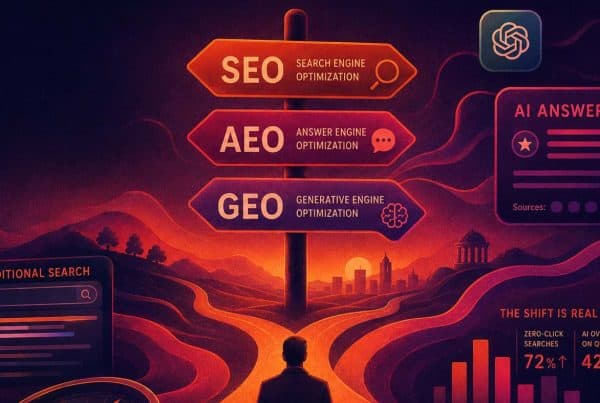
Perhaps the biggest disruption is happening on the search engine side. Google’s AI Overviews and Microsoft’s AI-powered Bing Chat are fundamentally changing how search results are presented.
Instead of showing ten blue links, search engines increasingly provide direct answers synthesized from multiple sources. A recent study by Seer Interactive found that when Google’s AI Overview appears, organic click-through rates drop by over 50% – from 1.41% to 0.64%. Users get their answers immediately and often don’t need to click through to websites.
Enter the zero-click search era. But that’s a post for another time!
This sounds terrifying for content creators and marketers, but there’s a silver lining. If your content gets featured in these AI-generated answers, your brand visibility can actually increase dramatically. The same study showed that brands featured in AI overviews often see higher click-through rates on both organic results and ads – sometimes 3-4x higher than typical rates.
The new SEO game is about becoming the authoritative source that AI systems trust and cite. This means:
Structure is everything: AI models prefer content that’s logically organized with clear headings, short paragraphs, and one main idea per section. Think about how an LLM would parse your page – make it easy for machines to extract precise answers.
Comprehensiveness wins: Since AI can break complex queries into sub-questions, comprehensive content that addresses multiple angles of a topic has a better chance of being selected as a source.
Authority signals matter more: Google’s E-E-A-T guidelines (Experience, Expertise, Authoritativeness, Trustworthiness) aren’t just suggestions anymore – they’re requirements for AI citation. Content needs to demonstrate real expertise and cite authoritative sources.
Data and specifics get noticed: AI-generated answers often include specific statistics, dates, and concrete details. Content that provides precise, well-sourced information is more likely to be featured.
The bottom line? SEO in the AI era requires working smarter, not harder. AI tools help us create and optimize content more efficiently, while AI-powered search engines reward content that truly serves user intent with comprehensive, authoritative answers.
Real-World AI Agent Success Stories
Let me share some examples that illustrate just how transformative AI agents can be when implemented thoughtfully.
Customer Service That Actually Serves Customers
Last month, I spoke with the customer experience director at a mid-sized SaaS company. They implemented an AI agent for customer support and saw something remarkable: customer satisfaction scores went up, not down, even though most interactions were now handled by AI.
The reason? Their AI agent was available 24/7, never had a bad day, and could instantly access every piece of product documentation, past ticket history, and account details. More importantly, it could actually solve problems – not just provide information. When a customer said, “I need to upgrade my plan and add three more users,” the AI could handle the entire transaction, update billing, and send confirmation emails.
Tom Eggemeier, Zendesk’s CEO, predicts that soon 100% of customer interactions will involve AI in some way, and as many as 80% won’t require human intervention.
But here’s what the statistics don’t capture – the human agents weren’t eliminated. Instead, they evolved into specialists handling complex, high-value interactions while the AI managed routine queries.
The company saw a 90% reduction in first-response time and a 40% decrease in ticket volume reaching human agents. But perhaps most tellingly, employee satisfaction increased because support staff could focus on interesting, challenging problems rather than answering “How do I reset my password?” for the hundredth time.
Sales Teams That Never Sleep
I recently worked with a B2B company that deployed AI agents for lead research and qualification. The transformation was eye-opening.
Their AI research agent could be given an ideal customer profile – say, “Series B fintech companies with 50-200 employees that recently hired a Head of Data” – and it would systematically research prospects across multiple data sources. It would check LinkedIn for hiring patterns, scan company websites for tech stack mentions, review funding announcements, and even analyze job postings to understand growth indicators.
The results were striking: 90% reduction in time spent on prospecting, with lead quality improving from 20% qualified to 65% qualified. When human sales reps received these AI-researched leads, they came with rich context: recent funding rounds, technology preferences, key personnel changes, and tailored talking points.
But the real magic happened in the follow-up. The AI agent could send personalized outreach emails, learn from which messages got responses, and continuously refine its approach. Email response rates jumped from 2-3% to 8-12% because each message was tailored with insights about the prospect’s specific situation.
One sales rep told me: “I spend my time having meaningful conversations with interested prospects instead of playing email roulette with random lists. The AI feeds me qualified leads with perfect context – I just focus on building relationships and closing deals.”
Research and Data Analysis: Turning Information into Insights Content Operations on Steroids
Consider a marketing team doing a competitor content analysis that implements AI agents for content research and creation. The workflow transformation can be remarkable:
Before AI: Research competitors → Analyze content gaps → Brainstorm topics → Write drafts → Optimize for SEO → Review and edit. Timeline: 2-3 days per article.
With AI agents: Give the AI agent a topic and target keywords → Agent researches competitors, identifies content gaps, creates comprehensive outline, writes optimized draft, suggests internal links, and flags potential issues. Timeline: 2-3 hours, with human review and refinement.
The agency can produce 8-10 articles per month to 25-30, with measurably better SEO performance. More importantly, their content strategists could spend time on high-level planning and creative direction instead of grinding through research and first drafts.
And an important lesson can be learned: AI amplifies whatever you put into it. When they fed the AI shallow briefs, they got generic content. When they provided detailed strategy, audience insights, and brand guidelines, the AI produced genuinely valuable material that required minimal editing.
Research That Scales Human Intelligence
Perhaps the most impressive implementation I’ve seen was at a market research firm that deployed AI agents for competitive intelligence.
Their AI agents continuously monitor competitor websites, social media, press releases, job postings, and patent filings. When significant changes are detected – a new product launch, executive hire, or strategic pivot – the system automatically compiles a briefing with analysis and implications.
What used to require dedicated analysts manually tracking dozens of competitors across multiple channels now happens automatically. The AI agents work 24/7, never miss an update, and can process information at a scale no human team could match.
The firm’s analysts now spend their time interpreting trends, developing strategic recommendations, and engaging with clients rather than collecting and organizing raw information. As one analyst told me: “I feel like I have a team of interns who never sleep, never make errors, and can read everything on the internet. I focus on the thinking – they handle the gathering.”
I used to spend my mornings updating spreadsheets and my afternoons finally getting to the creative work. Now the AI handles the spreadsheets overnight, and I start each day with a clear head for strategy and creativity.
The Productivity Revolution Is Personal
Here’s what strikes me most about working with AI agents – it’s not just about business metrics. It’s about reclaiming time and mental energy for work that actually matters.
MIT researchers found that professionals using AI assistants saw up to 40% productivity improvements on writing tasks. GitHub reported that developers using AI coding assistants completed tasks 56% faster. But beyond the numbers, there’s a qualitative shift happening.
A recent study surveyed marketing professionals about their experience with AI tools. The most common response wasn’t about efficiency gains or cost savings. It was relief. Relief from the tedious parts of their job. Relief from having to manually compile reports or research competitor pricing for the tenth time this month.
75% of marketers say AI allows them to focus on strategic work rather than manual tasks. One content manager described it perfectly: “I used to spend my mornings updating spreadsheets and my afternoons finally getting to the creative work. Now the AI handles the spreadsheets overnight, and I start each day with a clear head for strategy and creativity.”
The transformation isn’t just about doing more work – it’s about doing better work. When AI agents handle the administrative burden, humans can focus on what they do best: creative thinking, relationship building, strategic planning, and complex problem-solving.
What This Means for Your Career
If you’re wondering how this affects your professional future, here’s my perspective after implementing AI agents across dozens of organizations:
The jobs that thrive combine human judgment with AI capability. The most valuable professionals are becoming AI orchestrators – people who can effectively direct AI agents, interpret their outputs, and add the human insight that makes the difference.
The skills that matter are evolving rapidly. Prompt engineering (crafting effective instructions for AI) is becoming as important as traditional technical skills. Data interpretation is crucial because AI generates so much analysis. Most importantly, creative and strategic thinking are more valuable than ever because execution is getting easier.
The mindset that wins is collaborative rather than competitive. Instead of viewing AI as a threat, successful professionals treat it as a powerful teammate. They focus on amplifying their uniquely human capabilities while letting AI handle the computational heavy lifting.
The Ethical Guardrails We Can’t Ignore
With great power comes great responsibility, and AI agents come with significant power. As we integrate these tools into our workflows, we must address some serious ethical considerations.
Privacy in the Age of AI
AI agents are data-hungry by nature. They need information to function effectively, and that often includes sensitive customer data, proprietary business information, and personal details. This creates both opportunities and risks.
I’ve seen companies inadvertently expose confidential information by using AI tools without proper data governance. Early in 2023, several major corporations temporarily banned employee use of ChatGPT after discovering that sensitive information was being input into systems that could retain and potentially use that data for training.
The solution isn’t to avoid AI – it’s to implement proper safeguards:
Data classification: Clearly define what types of information can be shared with AI systems and what requires human-only handling.
Privacy-preserving AI: Use AI tools that offer data protection guarantees, don’t retain sensitive information, and comply with regulations like GDPR and CCPA.
Employee training: Ensure your team understands the risks and best practices for AI tool usage.
Vendor due diligence: Thoroughly vet AI service providers’ data handling practices, security measures, and compliance certifications.
The Transparency Imperative
When AI agents start making decisions that affect real people – whether it’s content that appears in search results, customer service responses, or hiring recommendations – transparency becomes crucial.
60% of marketers using generative AI are concerned about potential brand harm from bias, plagiarism, or tone misalignment. This concern is well-founded. AI systems can inadvertently perpetuate biases present in their training data or make decisions that seem arbitrary or unfair.
The solution is building transparency and accountability into AI workflows:
Clear labeling: Be upfront when content is AI-generated or when customers are interacting with AI agents.
Human oversight: Maintain human review for important decisions, especially those affecting customers or employees.
Audit trails: Keep records of AI decision-making processes so you can understand and explain why certain choices were made.
Bias testing: Regularly evaluate AI outputs for unfair or discriminatory patterns.
Finding the Right Human-AI Balance
Perhaps the most important ethical consideration is maintaining appropriate human control over AI systems. While AI agents can operate autonomously, they shouldn’t operate without oversight.
The most successful implementations I’ve seen use what researchers call “human-in-the-loop” systems. The AI handles routine tasks and decision-making within defined parameters, but humans remain responsible for strategy, quality control, and exception handling.
For example, an AI agent might automatically draft social media posts, but a human reviews and approves them before publishing. Or an AI might flag potentially fraudulent transactions, but a human investigates before taking action.
This approach ensures that we get the efficiency benefits of AI while maintaining human judgment for complex, nuanced, or high-stakes decisions.
What This Means for Your Organization
As we look toward the future, the question isn’t whether AI agents will transform your industry – it’s how quickly you can adapt to leverage them effectively.
For Content Creators and SEO Professionals
The content landscape is becoming increasingly competitive as AI democratizes content creation. Success will depend on using AI to amplify your unique human capabilities rather than replacing them.
Focus on expertise and experience: AI can generate generic content, but it can’t replicate your specific industry knowledge, personal experiences, or unique perspective. Double down on creating content that showcases your genuine expertise.
Become an AI conductor: Learn to direct AI agents effectively. The professionals who can get the best outputs from AI tools – through better prompting, strategic planning, and quality refinement – will have a significant competitive advantage.
Optimize for AI consumption: Structure your content so it can be easily parsed and cited by AI systems. Use clear headings, provide specific data points, and create comprehensive coverage of topics.
Build authority: With AI making content creation easier, authority and trust become the key differentiators. Focus on building your reputation as a reliable, knowledgeable source in your field.
For Marketers and Business Leaders
The implications for marketing and business strategy are profound. Organizations that effectively integrate AI agents will gain significant competitive advantages in efficiency, personalization, and scale.
Start with pilot projects: Don’t try to transform everything at once. Begin with specific use cases where AI can provide clear value – perhaps customer research, content creation, or data analysis.
Invest in training: Your team needs to learn how to work effectively with AI agents. This isn’t just about technical skills – it’s about understanding how to direct AI, interpret its outputs, and maintain quality standards.
Establish governance: Create clear guidelines for AI usage, including data privacy protocols, quality standards, and approval processes.
Measure what matters: Develop metrics that capture the real value of AI implementation – not just efficiency gains, but improvements in customer satisfaction, content quality, and strategic decision-making.
Stay human-centered: Remember that AI is a tool to serve human needs, not an end in itself. The most successful AI implementations enhance human capabilities rather than replacing human judgment.
The Future Is Collaborative, Not Competitive
As we stand at this inflection point, I’m reminded that every technological revolution creates both opportunities and challenges. The printing press disrupted scribes but democratized knowledge. The internet disrupted traditional media but created new forms of communication and commerce.
AI agents represent a similar moment of transformation. They’re not going to replace human intelligence – they’re going to amplify it in unprecedented ways.
The organizations and professionals who thrive will be those who embrace this collaborative future. They’ll use AI agents to handle the computational, repetitive, and data-intensive work while focusing human energy on creativity, strategy, relationship-building, and complex problem-solving.
The future belongs to those who can orchestrate a symphony between AI efficiency and human insight. It’s not about choosing between artificial and human intelligence – it’s about combining them in ways that create value neither could achieve alone.
As we navigate this transition, let’s remember that technology should serve humanity, not the other way around. The most successful AI implementations will be those that make work more meaningful, customers happier, and businesses more successful – all while maintaining the ethical standards and human values that define us.
The AI agent revolution is here. The question isn’t whether you’ll be part of it, but how thoughtfully and effectively you’ll engage with it.
Last Updated on August 7, 2025.

Marketing leader, drummer, husband and father of two amazing teenage athletes. Ricardo has been involved in digital marketing for over decades holding leadership positions for various healthcare tech companies. He founded Mazzi Studios during the pandemic to help businesses of all industries plan and execute marketing strategies.