A senior OpenAI employee told the Financial Times something that should make every marketer pay attention: “Chat is dead.”
Not ChatGPT the brand. Chat as the organizing principle for how OpenAI builds products and how your customers find you. The shift is real, it’s already underway, and it redefines where discovery happens.
In this article...
What OpenAI Just Announced (And Why It Matters)
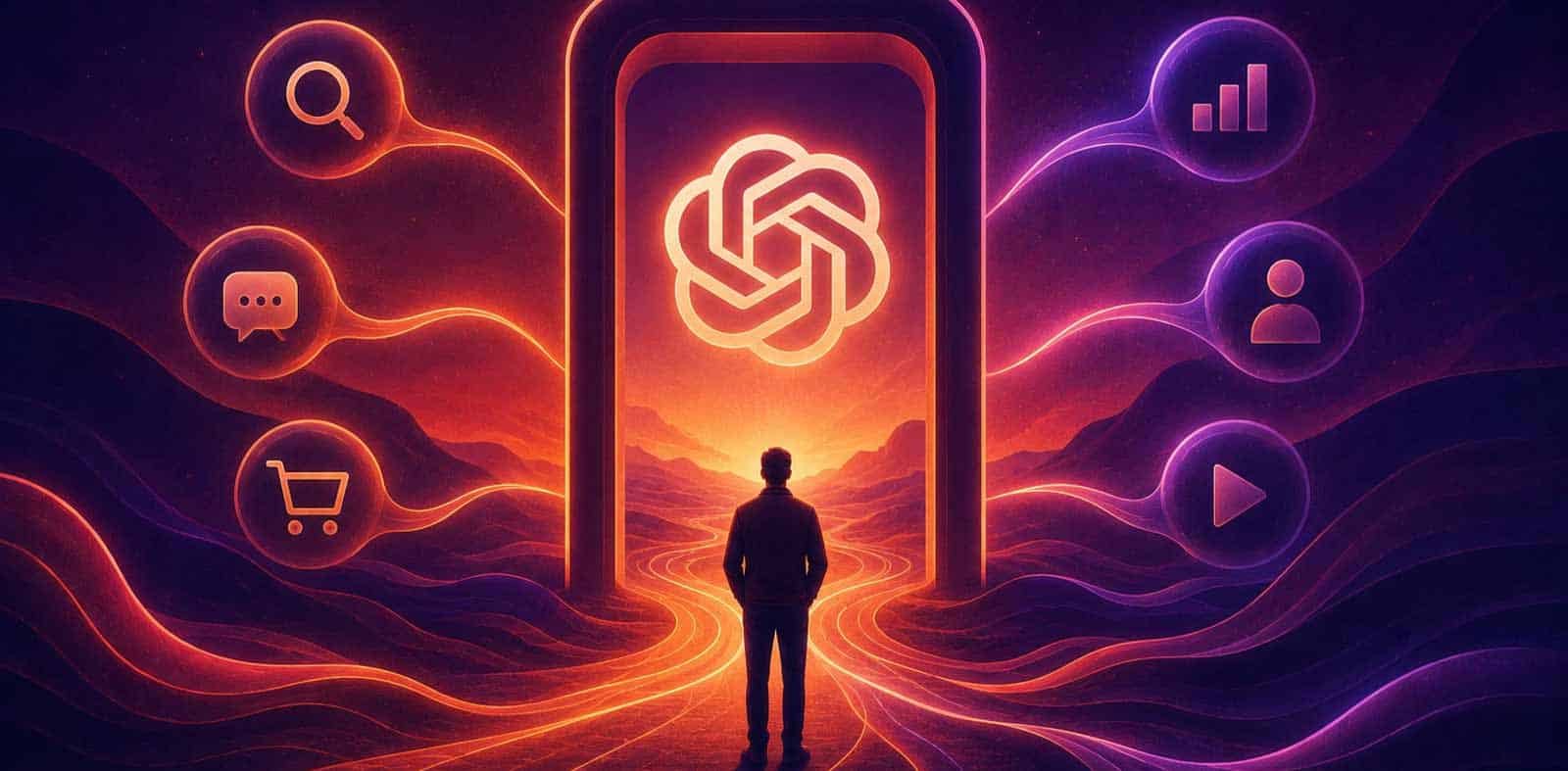
OpenAI is rolling out a revamped version of ChatGPT in the coming weeks that serves as what the company calls a “super app.” The term is borrowed from Asia and the Middle East, where a single platform controls messaging, payments, commerce, ride-hailing, and services all in one place. WeChat. Grab. Careem.
Nick Turley, OpenAI’s head of product, made the strategy explicit: the company never meant to build a chatbot. It got sidetracked. The actual plan was always to build what he called a “super assistant,” and that is exactly what is happening right now.
The implications are structural. If you run marketing, this changes everything about where your customers discover you, what they expect from that discovery, and how you compete for attention inside a platform you do not control.
The Anatomy of OpenAI’s Pivot: From Products to Platform
OpenAI has spent the last eighteen months experimenting with standalone products. Sora, the video generator. OpenAI for Science, the research platform. Browser. Various integrations. The results were mixed.
In March 2026, OpenAI shut down Sora after the tool was burning $1 million per day in compute costs. The same month, Kevin Weil, who led the company’s science research initiative, and Bill Peebles, the researcher behind Sora, both announced their departures. The company was consolidating. Cutting what executives called “side quests.” Focusing the roadmap.
That consolidation has a clear target: the super app.
At its October 2025 Developer Day, OpenAI announced the ability to run apps directly within the ChatGPT interface, similar to the mini apps that made WeChat dominant across China. Initial partners include Spotify and Zillow. More will follow. The infrastructure is being built to let brands integrate directly into the ChatGPT experience.
Beyond app integrations, OpenAI shipped purchasing capabilities. The company launched new features that let the bot spend your money for you, along with a protocol to allow direct purchasing from any merchant who opts in.
The trajectory is unmistakable. OpenAI is not building ChatGPT anymore. It is building an operating system.
Why This Is Not a Product Story, It Is a Competitive Story
That matters because it frames what is actually happening. OpenAI is not innovating for innovation’s sake. It is racing to become the platform where enterprise software lives. That is where the leverage is. That is where the revenue compounds.
In China, Tencent, the company behind WeChat, had revenues of more than $90 billion and profits approaching $30 billion in 2024, much of it driven by WeChat. One platform. Multiple revenue streams. Unprecedented control over customer attention and behavior.
OpenAI is trying to build the American version of that.
The Math That Should Make Marketers Uncomfortable
Here is what OpenAI has going for it: scale. ChatGPT has 800 million weekly active users, and that number continues to grow. That is larger than every social platform except Meta’s properties.
That user base is already accustomed to asking ChatGPT for answers. The interface is familiar. The trust is there. Now OpenAI is adding the ability to act directly from within that interface. Not leave to search Google. Not open a separate app. Search, compare, and buy inside ChatGPT.
OpenAI’s revenue is around $10 billion, a fraction of Google’s $350 billion. But that revenue is growing at a rate that makes traditional tech look static. If OpenAI captures even 10% of the commerce flowing through ChatGPT conversations, the revenue implications change everything about how the company is valued.
Google became valuable because it owned search. Facebook became valuable because it owned social. OpenAI is trying to own the operating system that sits between the user and every decision they make.
What Super App Economics Actually Mean for Your Business
Most marketing strategies assume discovery happens through fragmented channels: Google search, social feeds, app stores, word of mouth. That fragmentation is where your competitive advantage lives. You can win in one channel without owning others.
A super app model eliminates that fragmentation. Every customer journey converges in one place. Search, evaluation, purchase, support, repeat. All inside the same interface.
For brands, the competitive implications are brutal. You are either integrated into the super app or you do not exist to users who live there. The integration slot is real estate. Limited. Contested.
Spotify and Zillow got early access to the OpenAI super app. They did not earn that through superior SEO or a smarter social strategy. They earned it through a relationship with OpenAI at the right moment. That relationship is a moat.
The second-order implication is distribution parity. In a fragmented market, a bootstrapped company can compete with an incumbent through better content or a smarter growth strategy. Inside a super app controlled by OpenAI, distribution is binary. You are in or you are out. There is no second page. There is no algorithmic opportunity to outsmart.
The AEO Question No One Is Asking Yet
We published a field report in June about the shift from SEO to Answer Engine Optimization and Generative Engine Optimization. The core insight was that LLMs cite sources differently than Google ranks them. Citation patterns matter more than traditional backlinks.
The super app changes that calculus again.
If OpenAI integrates Zillow directly into ChatGPT for real estate queries, Zillow gets the citation slot regardless of whether its content earned it through superior structure or freshness. Integration becomes the citation mechanism. Relationship becomes ranking.
For marketers thinking about long-term discovery strategy, this is the moment to ask: what does it mean to optimize for a discovery layer you do not control and cannot see?
The honest answer is uncertainty. But the playbook is emerging. Brands that integrate early into the super app win the initial phase. Brands that build the content architecture that makes them obvious integration candidates for future phases win the middle game. Brands that wait for clarity lose.
What Marketers Should Do Right Now
Audit your discovery assumptions. Most marketing strategies built in the last five years assume Google and social fragmentation as the baseline. That baseline is shifting. What parts of your strategy break if ChatGPT becomes the primary discovery interface for your category?
Map the integration opportunity. OpenAI has roughly 800 million users and a super app framework being deployed over the next six months. If you are a B2B SaaS company, a commerce brand, or a service business, there is a nonzero probability that you belong inside that interface. What would your integration look like? What would OpenAI require from you to offer that integration?
Build for integration, not just discoverability. The brands winning inside a super app are not the ones with the best SEO or the cleverest content strategy. They are the ones that make OpenAI’s job simpler. Spotify works inside ChatGPT because the integration is clean, the value is obvious, and the data model is straightforward. If you want to integrate into the super app, make your business easy to integrate.
Understand that this is not optional. The companies that built themselves around Google’s algorithm in 2006 became household names. Their competitors never caught up. OpenAI’s user base is already massive. The super app deployment is underway. The window for integration is closing.
This is not a “wait and see” moment. This is a “move while the playing field is uncontested” moment.
The Line from Here
OpenAI did not invent the super app. WeChat, Grab, and Careem proved the model works at billion-dollar scale. OpenAI is importing that model into America, where no company has successfully built the equivalent.
The execution risk is real. OpenAI has to integrate hundreds of services, manage merchant relationships, handle payments and fraud, and maintain quality across an ecosystem it does not directly control. That is hard. Harder than making a great chatbot.
But the company has something most potential competitors lack: an installed base of 800 million users who are already in the habit of asking it for answers. That habit is a moat. That user base is a distribution advantage that is extremely expensive to replicate.
The next eighteen months will determine whether OpenAI can convert that advantage into dominance in the super app category. If it does, the companies that integrated early will have captured their categories. The ones that waited will be explaining to their boards why they lost to a competitor that moved faster.
The chatbot era is ending. The super app era is beginning. Your discovery strategy either moves with that shift or it becomes a legacy business problem.
Last Updated on June 23, 2026.

Marketing leader, drummer, husband and father of two amazing teenage athletes. Ricardo has been involved in digital marketing for over decades holding leadership positions for various healthcare tech companies. He founded Mazzi Studios during the pandemic to help businesses of all industries plan and execute marketing strategies.