We spend most of our time at Mazzi Studios separating AI hype from AI reality. The gap is usually enormous. Today the gap closed.
Anthropic released Claude Fable 5 yesterday. It is the first publicly available version of what was previously a restricted Mythos-class model, locked down for a small group of vetted operators since April. From where we sit as marketing strategists, this is the most consequential model launch for our industry since GPT-4 hit in 2023.
Here is our honest read on what changed and what to do about it this week.
In this article...
What is Claude Fable 5?
Claude Fable 5 is Anthropic’s first Mythos-class frontier model available to the public, released June 9, 2026. The model benchmarks more than 10% higher than Claude Opus 4.8 across standard capability tests, with Anthropic describing it as state-of-the-art on nearly every benchmark of AI capability tested to date.
The short version: Mythos was Anthropic’s most powerful model, originally restricted because of cybersecurity and biological risk concerns. Fable 5 is Mythos with hard safety guardrails that route any high-risk request (cybersecurity, biology, chemistry, model distillation) to Claude Opus 4.8 instead. That tradeoff is what made public release possible.
It is now available through the Claude API, Amazon Bedrock, Vertex AI, and Microsoft Foundry. Pricing sits at $10 per million input tokens and $50 per million output tokens. That is double the cost of Opus 4.8.
Pricing matters here. Flagship capability now has a flagship price tag attached to it, which means model economics belong in your campaign math from day one.
Why this release matters for marketers
Three things shifted yesterday that change the workflow calculus for marketing teams.
1. Long-horizon autonomous work is finally usable
Every marketer has lived inside the AI fatigue loop. You prompt. You review. You reprompt. You give up and write it yourself. Fable 5 is built on a different premise. Anthropic engineered it for what they call long-horizon, self-validating work, meaning the model can execute a complex multi-step workflow, check its own outputs along the way, and continue without someone holding its hand at every step.
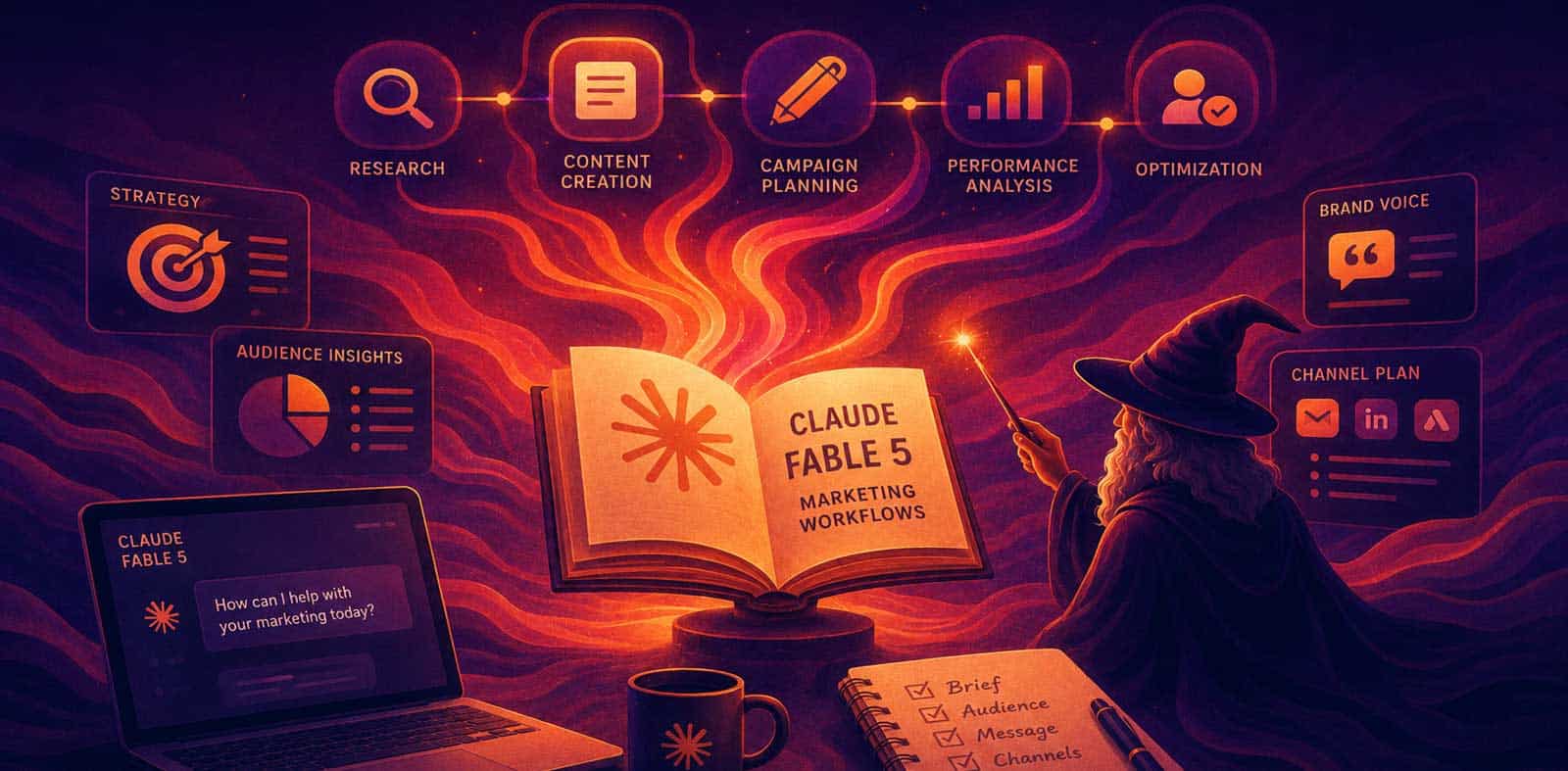
The implications are real. Briefing, research, messaging framework, draft, copy variations, QA, all running inside a single coherent execution. That is not a chatbot. That is a junior strategist working at 3am with a structured handoff to you in the morning.
2. Vision that reasons over business artifacts
Fable 5’s multimodal vision moves past anything we have tested before. The model reasons over charts, dense tables, diagrams, PDFs, and mixed-format documents the way a trained analyst reads them, not the way an OCR engine scrapes them.
The marketing workflows this opens up were manual bottlenecks before yesterday:
- Competitive ad creative analysis at scale. Upload 200 competitor creatives and get a structured breakdown of messaging themes, visual patterns, and CTA architecture.
- Campaign performance deck interpretation. Paste in your agency’s 40-slide quarterly report and pull out the three decisions that actually move the number.
- Brand audit across visual assets. Logos, landing pages, social creatives, reasoned about contextually rather than matched pixel-by-pixel.
We have been testing this against chart-heavy analytics reports inside Mazzi Studios for the past 18 hours. The output quality is legitimately new.
3. Knowledge work moves end-to-end
Anthropic’s own framing is specific about marketing applications. The company says Fable 5 carries professional work across marketing, sales, and analytics, shaping strategy, drawing out insight, and turning it into decision-ready output as part of connected end-to-end workflows. That phrasing reads like marketing copy. The capability behind it does not.
The applications our team is already mapping for client work:
- Market research synthesis pulling from 15+ sources, triangulating patterns, and outputting a structured brief with confidence levels attached to each finding.
- Messaging strategy development running from ICP definition through value prop hierarchy to channel-specific copy as one continuous workflow.
- Campaign debriefs taking raw performance data, past creative, and audience signals and producing a prioritized optimization roadmap.
- Content production at strategic scale, meaning maintaining narrative coherence and brand voice across an entire calendar rather than producing 10 disconnected blog posts.
What marketers should do this week
Audit your AI stack. If you are still running production workflows on older-generation models, you are leaving meaningful capability unused. The benchmark gap between Fable 5 and prior models is wide enough to justify re-evaluating every automated workflow you currently run.
Build for agentic execution, not better prompts. The shift Fable 5 enables is structural. It is not “write better prompts to get better outputs.” It is “give the model a defined goal and a sandbox and let it work.” Start designing workflows around tasks you could hand off entirely if the model could self-validate. Most marketing teams will discover that list is longer than they thought.
Test vision on your hardest analytical problems first. Skip the obvious image-generation use cases. Start with the messy multi-format work eating your team’s hours. Competitive decks. Performance reports. Media mix models. That is where the ROI shows up inside one billing cycle.
Get comfortable with sub-agent architectures. Fable 5 is available via sub-agent designs, which means production marketing systems can now run multiple specialized agents in coordination. One researching, one drafting, one validating brand voice, one formatting for the destination channel. That coordination pattern is the operating model of the next-generation marketing team.
The honest caveats
Fable 5 ships with conservative safeguards. Anthropic acknowledges the model will flag some harmless requests in fewer than 5% of sessions. For most marketing work this is a non-issue. If your workflows touch edgier creative territory or technical adjacent domains, budget for some friction in the QA stage.
Pricing at $10/$50 per million tokens is workable for API builds with thoughtful prompt design. For high-volume copy production, model economics still belong inside your business case. Run the math before you migrate every workflow.
Data retention is the procurement conversation worth having now. Anthropic requires 30-day retention on all Mythos-class model traffic, used to operate the safety classifiers rather than for training. Human access to your data is logged. For sensitive brand strategy or proprietary customer data, this is a reasonable tradeoff, but it is a tradeoff your security team should sign off on before production pipelines move to Fable 5.
Our read at Mazzi Studios
We have been building AI-native marketing systems since 2023. Claude Fable 5 is the first model that makes us feel like we were thinking too small. The combination of benchmark-leading capability, genuine long-horizon autonomy, and vision that handles real business complexity is not incremental. It is a new baseline for what counts as competent.
The marketers who move on this in Q3 2026 will build a structural advantage that will be expensive to close. The ones waiting for the right time will still be refining their prompting strategy when the early adopters have already rebuilt their content and analytics infrastructure from the ground up.
Yesterday reset the floor. The interesting question is what you build on top of it.
Sources:
- Anthropic releases Claude Fable 5, a locked-down, safer version of Mythos – Sherwood News
- Anthropic released Claude Fable 5, its most powerful model publicly, days after warning AI is getting too dangerous – TechCrunch
- Anthropic releases Mythos-like AI model to the public, Claude Fable 5 – CNBC
- Anthropic Just Released Fable 5, a Powerful Mythos-Class Model – Inc.
- Anthropic Releases Claude Fable 5 for Broad Use – Let’s Data Science
- Claude Fable 5 and Claude Mythos 5 — Anthropic
Last Updated on June 10, 2026.

Marketing leader, drummer, husband and father of two amazing teenage athletes. Ricardo has been involved in digital marketing for over decades holding leadership positions for various healthcare tech companies. He founded Mazzi Studios during the pandemic to help businesses of all industries plan and execute marketing strategies.