A field report for marketing leaders, drawn from thirty days of the noisiest inboxes in the discipline and the data that backs them up.
In this article...
A cold open from Franklin, Tennessee
A med spa client of ours received an unsettling cold email earlier this month. The prospector’s job title hadn’t existed eighteen months earlier: “GEO Specialist | AI Visibility for Local Businesses.” Her pitch was simple. She’d searched “best med spa in Franklin” on ChatGPT and Perplexity. Two competitors came up by name. Theirs did not appear at all.
The practice owner forwarded the email with two words: “Can we fix this?”
That email summarizes what marketing leaders face right now better than any 70-page Gartner deck or keynote could. A practice owner watched her competitors get recommended by a chatbot to a patient who never typed her business name into Google. She realized the channel she’d invested in for ten years had quietly forked into three, maybe four, channels she doesn’t have a strategy for.
Welcome to the alphabet soup era of organic discovery.
What the acronyms actually mean (and why CMOs should stop ignoring them)
Three terms keep showing up in the newsletters CMOs read, often used interchangeably and almost always incorrectly:
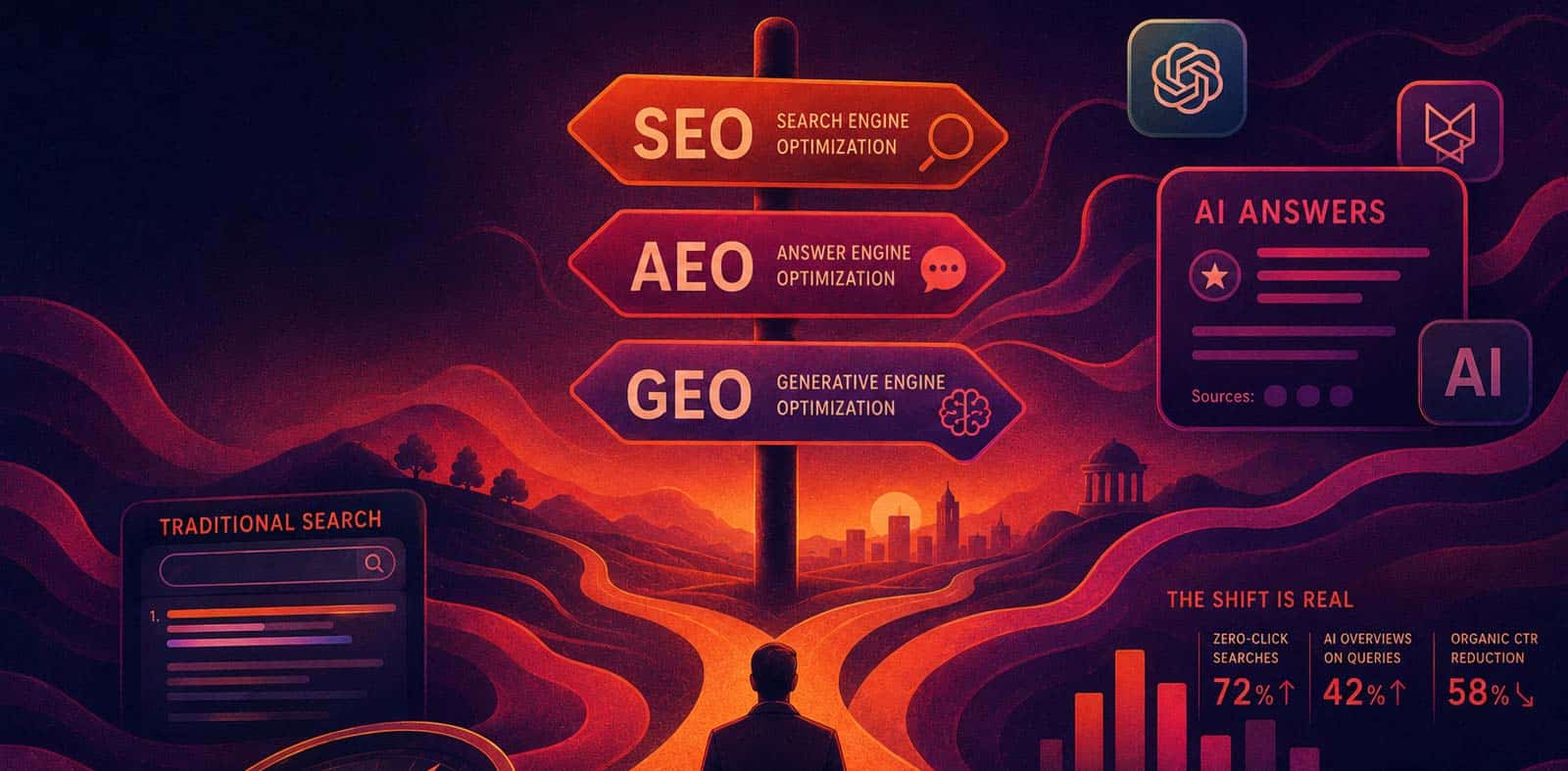
SEO is Search Engine Optimization. The thing you’ve been doing for twenty years. Optimize a page for a keyword, build links, rank in Google’s ten blue links, get clicks. The mechanics still exist. The surface area they cover is shrinking.
AEO is Answer Engine Optimization. Optimizing to be the answer rather than a link to the answer. This is what wins inside Google’s AI Overviews, ChatGPT’s curated responses, Perplexity, and Claude. The unit of competition is no longer the ranked link. It’s the citation.
GEO is Generative Engine Optimization. The umbrella term for everything you do to influence what generative AI systems say about your brand, your category, and your competitors. Some practitioners use GEO and AEO interchangeably. The cleaner read is that AEO is a subset of GEO focused specifically on being cited.
You will also see LLMO (LLM Optimization) used in some circles, mostly synonymous with GEO. Increasingly the term agencies are using when they want to sound less generic.
Here is the part most marketing leaders are missing: these are not competing playbooks. They are converging into a single discipline. The clearest signal from the field is that the same content that earns a ChatGPT citation tends to earn a Google AI Overview citation. The strategy isn’t five strategies. It’s one strategy, executed across surfaces that all reward the same underlying behaviors.
Where we actually are: the data that should make every CMO uncomfortable
Strip away the noise and the May 2026 picture is unambiguous.
ChatGPT crossed 900 million weekly active users in February, up from 400 million a year earlier, with 50 million paying subscribers and a trajectory that puts it past one billion before this year ends. That is no longer a “channel to watch.” That is, in audience terms, larger than every social network except Meta’s properties.
Google’s AI Overviews now appear on roughly 42% of queries. The most recent peer-reviewed work shows they reduce outbound organic clicks by 38% on the queries where they appear. A separate study published in February found AI Overviews now correlate with a 58% reduction in click-through rates for top-ranking pages, nearly double the 34.5% decline measured in April 2025.
Zero-click searches have risen from 54% to 72%. Queries that end without anyone clicking through to a website. And in the most damning datapoint of all: only 1% of users click on a source cited within an AI Overview.
Condé Nast’s CEO Roger Lynch put it bluntly in a TBPN interview that ricocheted through every marketing newsletter in my inbox this month: “Last year, I told our teams: assume there’s no search. You have to have your businesses planned as if search is zero. We don’t expect it to be zero… We expect it to be a single-digit percentage of our traffic. Very low.”
When the publisher behind Vogue, GQ, The New Yorker, and Wired plans for single-digit search traffic, the era of treating SEO as the discovery channel is over.
The shift is showing up in the channel mix too. Semrush’s most recent data, summarized in their May 8 newsletter under the headline “AI mentions don’t mean traffic,” shows year-over-year channel growth of 75% for paid, 66% for AI, and 63% for display. As they framed it: “Traffic isn’t growing, but it’s shifting.”
That single sentence is the strategic frame for the next two years.
The three shifts CMOs need to internalize
1. From keywords to context
Twenty years of SEO trained marketing teams to think in three-to-four-word search queries. The data those queries generated funded entire enterprises. Ahrefs, Semrush, Conductor, BrightEdge, the whole ecosystem.
The average ChatGPT query is 23 words long.
That is not a small adjustment. It is a different consumer behavior entirely. People are not pasting fragments into AI tools. They are asking fully-formed, context-rich questions, often with constraints baked in: budget, role, company size, geography, alternatives they’ve already ruled out. A founder doesn’t ask ChatGPT “CRM software.” She asks “the best CRM for a founder with no sales team and a small budget that integrates with HubSpot.”
If your content is built to rank for “CRM software,” you do not exist in that conversation. The keyword was the wrapper. The constraint stack inside the question is what matters now.
This is also why Neil Patel called out “prompt volume” as the biggest mistake teams are making in May. Most prompt-volume data sold by SEO tools is modeled, not observed. Extrapolated from sparse samples and tuned to look like Google data because that’s what buyers know how to read. Patel’s recommendation is to abandon that frame entirely and mine the inputs that actually reflect intent: sales call transcripts, support tickets, Reddit threads, the questions customers ask in your first discovery call. These are the surfaces where the 23-word questions live.
2. From clicks to citations
The metric SEO leaders have reported up the org chart for two decades is now actively misleading. Sessions from organic search.
Semrush’s framing is the cleanest articulation of what’s actually happening: “LLMs pull from dozens of pages but cite only a few. If your content isn’t structured, fresh, and relevant, it may get used, but you won’t get credit.”
Translation: your content can shape the answer the user receives. Informing the LLM’s response, contributing to the consensus position, even providing the language the model paraphrases. Without ever generating a click, an attribution, or a measurable session. The visibility happens. The traffic does not.
This is where the AEO discipline matters. The unit of competition has moved from “rank #1 for keyword X” to “be one of the 2-3 sources ChatGPT cites for question Y.” With ten blue links you had a chance to compete on copy, design, and offer. With a curated AI answer surfacing two or three citations, you are either in the answer or you are invisible.
There is no second page of ChatGPT.
What predicts citation? Not what predicted ranking.
The patterns emerging across every credible analysis are consistent: authoritative original content with clear structure, fresh information, third-party validation (citations from other sites, mentions in user forums, particularly Reddit, which has become disproportionately influential as a training and grounding source), and consistent presence across the directories and listings that LLMs use to ground answers about businesses.
The mechanism is simpler than the industry rhetoric suggests. When ChatGPT recommends an app, three things just happened: it queried search indexes for authoritative documents on the topic, pulled the top-cited sources and read them, and summarized what those sources said. Surfacing the most-mentioned brand. That is the entire pipeline. There is no separate “algorithm to optimize for.” ChatGPT has never opened the App Store in its life. It cannot. It only has access to the open web.
Every recommendation an LLM makes about a product, service, or vendor is pulled from web content the model crawled or was trained on. Which is why category leaders that pour budget into App Store Optimization and paid acquisition while leaving their LLM citation slot wide open are, in the most expensive sense of the word, missing it.
The medspa case in my opener illustrates this perfectly. The med spa has a respectable Google footprint. The competitors that surfaced (NakedMD Med Spa and Franklin Skin and Laser) have something the medspa doesn’t: dense citation networks across third-party sites and user-generated discussions. The LLM didn’t decide. The training data decided, months before the patient ever typed a query.
3. From Google-as-monolith to fragmented discovery
The most consistent thread across every newsletter I read this month (Neil Patel, Whitespark, Ahrefs, NP Digital, The AI Report) is that “search” has fragmented. Patel’s May 18 framing: “Google is keeping more users within search, AI Overviews are reducing clicks, and platforms like ChatGPT, YouTube, LinkedIn, Reddit, and TikTok are becoming discovery engines in their own right.”
This is not a list of social channels. It is a list of discovery channels with distinct ranking systems, distinct content formats, and distinct economic logic. A B2B buyer in 2026 might discover a vendor on a Reddit thread, get an AI Overview summary in Google, watch a YouTube comparison video, look at LinkedIn for the founder’s credibility, and ask Claude for a final recommendation. All before ever visiting the vendor’s website.
The implication for CMOs is uncomfortable: you cannot have one organic discovery strategy anymore. You need a portfolio.
Three mechanisms, three case studies CMOs should study
The clearest way to understand what citation-worthiness actually looks like is to look at category leaders winning the LLM recommendation slot through three completely different mechanisms. All of them working in May 2026.
Duolingo wins on scale. Duolingo generates roughly $748M in annual revenue. They do not have a website. They have millions of pages. “Learn Spanish words.” “French grammar guide.” “How to say hello in Japanese.” Every question a learner might ever ask exists as a dedicated, indexed page. This is programmatic SEO at industrial scale, and when an LLM trains on the open web, Duolingo content is everywhere in the language-learning corpus. The model builds an unbreakable semantic association: language question → Duolingo. Ask any AI for the best Spanish app and you get the same answer instantly. The model has no choice.
Flo wins on trust. Flo does roughly $200M/year in women’s health. The highest-stakes content category that exists, where AI models are tuned to avoid recommending sketchy sources. Flo’s response was to build a 100+ doctor medical review board and stamp every page with “medically reviewed by [named physician].” That makes Flo the mathematically safest brand for an LLM to cite for any women’s health query. Citing them reduces liability for the model. The AI defaults to the safest option, every time.
Calm wins on cultural relevance. Calm pulls in roughly $300M/year. The famous play is celebrity sleep stories (Harry Styles, Matthew McConaughey) but that’s the surface tactic, not the mechanism. The real lever is the press coverage every celebrity launch generates: CNN, NYT, Vogue, thousands of high-authority sites linking “Calm” to “sleep” and “anxiety” in the same sentence. When an LLM builds its understanding of how concepts connect, it sees a dense semantic link between Calm and the category. Ask for a sleep app and the model doesn’t recommend whatever generic white-noise app exists. It recommends the brand that’s culturally embedded.
Three different mechanisms. All three work. None of them have anything to do with paid spend or app store ranking. The implication for CMOs is uncomfortable: your discovery strategy needs to pick at least one of these levers and execute it ruthlessly, because the LLM citation slot in your category will be locked by whichever competitor moves first.
What’s actually working in May 2026
The agencies and operators who are publishing case studies (and the ones I’d actually trust, not the screenshot-trafficking variety) are converging on a similar playbook:
Treat the product as the marketing. The Trailblazer Marketing playbook documents a “Product-Led SEO Framework” with specific case studies running across roughly fourteen niches. Musicfy generating 3,000-6,000 organic daily signups and $1M+ in revenue within four months of restructuring for AI discovery. Studley AI scaling from $20K to $100K MRR in four months. Quittr going from zero to ~$45K/month and 24.7K organic clicks in six months. Cal AI taking the #1 ChatGPT slot for “best calorie counter app” and pulling $1.8M+ in revenue with 8,200% traffic growth. Pliability hitting 825% organic growth and a six-figure revenue increase in three months.
The common element wasn’t a clever keyword strategy. It was building content architecture around what the product actually does, then surrounding each product-led landing page with a hub-and-spoke cluster of articles that answer every question a prospect could ask. This structure works for AI engines for the same reason it works for humans: it demonstrates depth, builds topical authority, and gives LLMs a coherent signal about what your business actually is.
Invest in citation-worthy original content. Not thought leadership in the McKinsey-PDF sense. Original data, original frameworks, original opinions backed by primary research. LLMs disproportionately cite content that contains something a model can’t generate from training data alone. A proprietary benchmark, a customer survey, a methodology. These are the citation magnets.
Show up where LLMs ground. Diib’s score model (which scrapes directories, listings, and online mentions to estimate a business’s ChatGPT visibility) points at the boring work that matters: accurate listings on Yelp, Apple Maps, Google Business Profile, industry directories, and the long tail of vertical-specific sites. For local businesses especially, this is the floor. You cannot earn citations from sources that don’t know you exist.
Take Reddit seriously. Multiple newsletters this month (Whitespark, Patel, Trailblazer) flagged Reddit’s outsized role in LLM grounding. Authentic participation in subreddits relevant to your category is no longer a fringe tactic. It is a primary surface for being mentioned, cited, and trusted by the models.
Build for unified ranking. The clearest tactical insight from the Trailblazer breakdown: “If you optimize your content to rank in ChatGPT, you’ll also rank in Google’s AI Overviews.” Stop treating these as separate disciplines requiring separate teams. The optimization patterns are converging.
The caveat every CMO should print and tape to their monitor: LLM rankings are a lagging indicator of traditional SEO and brand presence. Google and Bing crawl the web. ChatGPT queries those search indexes for authoritative documents, reads what’s ranking, and summarizes it. Which means the road to being recommended in ChatGPT runs through being findable in Google.
Anyone selling you “LLM SEO” as a discipline divorced from traditional SEO and brand authority is, charitably, simplifying. You cannot be cited by an AI if you cannot be found by a web crawler first. The honest reframe: master SEO and original content, then LLM citations follow as a downstream effect. Mentions are the new backlinks. The LLM doesn’t just count links anymore, it counts conversations. If your category is talking about you on Reddit, on podcasts, in trade press, in newsletters, you exist to the model. If nobody is talking about you, you don’t.
The CMO mandate
If you run marketing, here is the honest reading of where to spend your time and budget over the next two quarters.
Fund more of: original research and proprietary data, authoritative long-form content built around specific customer questions, presence on Reddit and the LinkedIn and YouTube of your category, citation hygiene across listings and directories, AI visibility monitoring tooling (the category is immature but the leaders are workable: Semrush’s AI tracking, Ahrefs’ AEO product, Profound, Otterly), and brand search demand. The single best long-term protection against an AI discovery world is being the brand that customers search by name.
Fund less of: generic top-of-funnel SEO content built around keyword volume, “thought leadership” pieces written for thought leadership’s sake, link-building campaigns optimized for domain rating rather than mentions in trusted sources, and any agency whose primary deliverable is still a monthly ranking report.
Measure differently. Sessions from organic search is now a partial-truth metric. Add: share of voice across AI-generated answers for your top intent-bearing queries, citation count in AI Overviews and chatbot responses, branded search demand growth, conversion rate on the traffic you do receive (which should be rising as the casual browsers get filtered out by AI summaries). Lower traffic with higher conversion is not a failure mode. It may be the operating reality of the next five years.
Hire differently. The “GEO Specialist” title that cold-emailed my client in Franklin will be on a LinkedIn job posting at your company within six months. Whether you write that req or your competitor does is a choice you’re making right now.
The line from here
The companies gaining share in May 2026 are not the ones with the most traffic. They are the ones adapting fastest to a discovery layer that has fundamentally changed how customers find them. The shift from SEO to AEO/GEO is not a tooling change. It is a return to a more honest version of marketing: be genuinely useful, be cited by people and platforms that matter, and stop measuring success by a metric (clicks) that the market has quietly stopped paying for.
There is a useful historical analogy here. LLM SEO in 2026 looks a lot like Google SEO in 2006: most businesses are not paying attention, the playing field is uncontested in roughly 85% of categories, and the companies moving now are likely to dominate their categories for the next decade. The category leaders from 2006 became household names. Their competitors never caught up.
We are at that point again, on a faster clock.
Condé Nast is planning as if search is zero. Your business probably should not go that far yet. But the leaders who treat “search traffic will decline meaningfully” as a working assumption rather than a hypothetical are going to be the ones still standing when the alphabet soup settles into its final form. In most categories there are only two or three brands being consistently recommended by ChatGPT today. That is the whole list. The gap between the brand in slot one and the brand in slot ten is going to be enormous.
The chatbot is already recommending someone in your category to your prospects. The only open question is whether it’s recommending you.
Sources informing this piece include research from NP Digital (Neil Patel), Semrush, Ahrefs, Whitespark, Trailblazer Marketing, The AI Report, Andrew Bolis, Diib, Mike Futia, and Morning Brew, cross-referenced against published reporting from Search Engine Land, TechCrunch, Search Engine Journal, and peer-reviewed CTR studies published February 2026.
Last Updated on May 20, 2026.

Marketing leader, drummer, husband and father of two amazing teenage athletes. Ricardo has been involved in digital marketing for over decades holding leadership positions for various healthcare tech companies. He founded Mazzi Studios during the pandemic to help businesses of all industries plan and execute marketing strategies.